Semiotics, philosophy and our desire to make meaning in branding and advertising
We don't just see things, we 'read' them.
In Martha Rosler's 1975 art performance video Semiotics of the Kitchen, Rosler stands in front of a kitchen counter and systematically introduces a series of domestic utensils – a fork, spatula, rolling pin, ladle, knife. She names them, but then begins to use them in gestures that are increasingly removed from our standard perception of the action tied to the object. Her actions feel angry and confrontational.
These kitchen utensils are 'signs' that women were at the time expected to use happily and contentedly. But through her reappropriation of actions, she highlights the oppressive forces placed on women. A spatula can be a spatula. It can also become a gesture of frustration, a symbol of domestic confinement, or even a weapon.
The object then carries meaning beyond its practical function. Objects become loaded with associations, histories and cultural codes.
Through semiotics, it is psychologically ingrained in human beings to associate and find meaning in every object. We are meaning-making machines. Semantics, on the other hand, is a branch of philosophy concerned with meaning – exploring how we perceive the external world, map meaning onto the things in it, and use that meaning to form an opinion or perspective. We use words, signs and symbols as the framework to find meaning and to process our ideas into real-world applications throughout our lives.
When we first tie semiotics to branding, we can see how our modern world is built on such structures. A brand's colours, a logo's shape, the typography used – all these elements act as markers of our own semiotic processing.
PUMA’S GO WILD – THE JOY OF BORROWED MEANING.
Whilst brands must look beautiful, they must also imbue meaning in each sign, image and gesture. So when we turn to semantics – the word is not the actual thing, the word signals the meaning we tie to it.
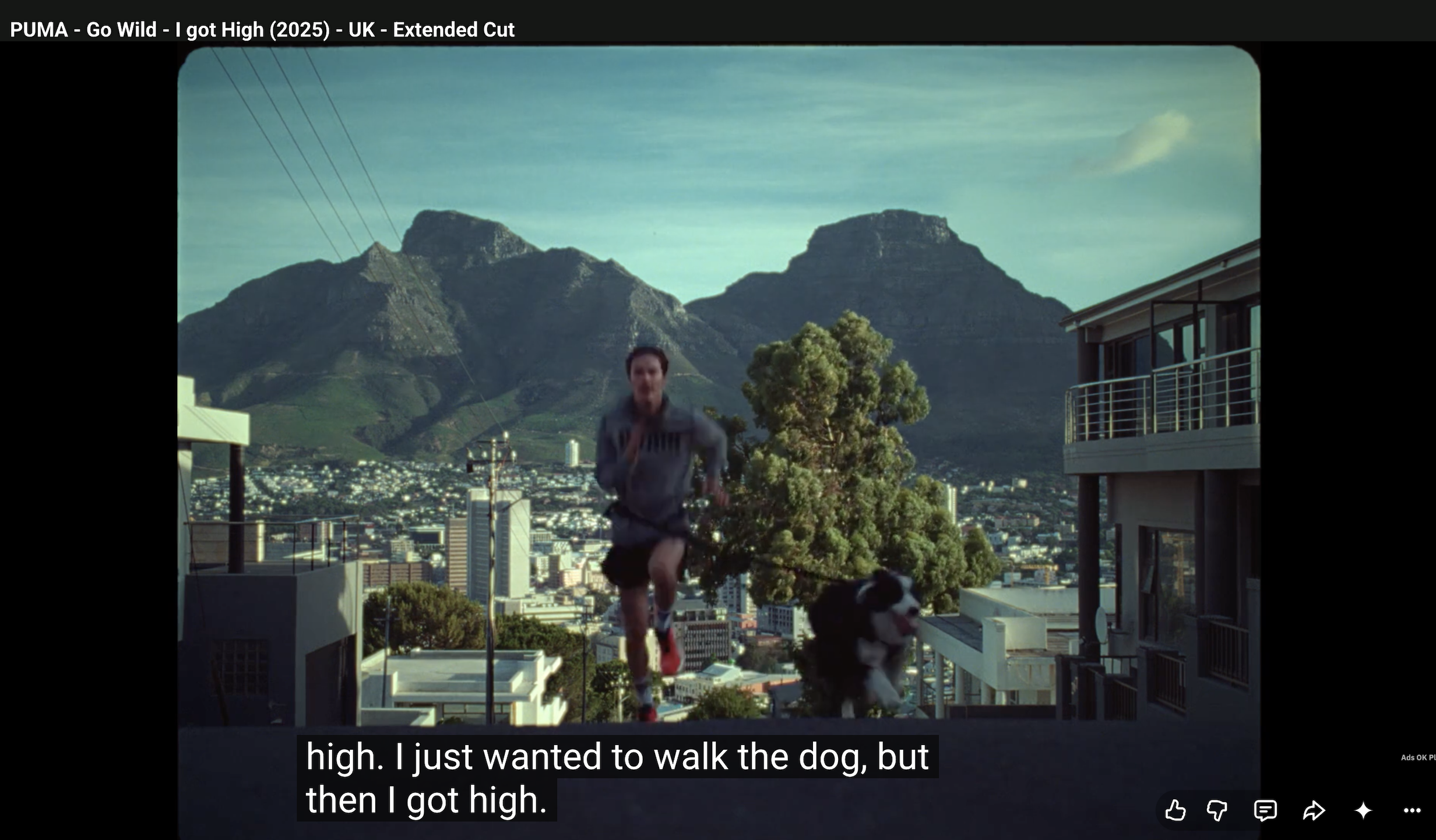
One of my favourite ads of late is Puma's Go Wild, and the way the language, music and message all play with meaning.
The campaign takes the familiar territory of the "runner's high" and gives it a deliberately irreverent twist, borrowing from Afroman's Because I Got High to turn the idea of getting high on its head. Here, the high isn't about excess or escapism, but the very ordinary pleasure of running.
That makes the semantic shift more than a clever cultural reference. The song, which was a huge hit at the time ('scuse the pun) and would have spoken to this exact audience, albeit at a younger stage in life, becomes a knowing joke about getting older without losing your appetite for fun. The campaign takes something its audience once associated with youthful rebellion and gives it a new meaning: the chemical rush, freedom and joy of running.
That linguistic playfulness is central to the wider brand idea. Go Wild sounds like a call to abandon restraint, but Puma uses it to mean something much more instinctive – to get outside and run for the sheer joy of it.
It's a brilliant callback to the nostalgia of the past and the joy that can be found in the present. There's a familiarity between the language and the people we see on screen – just everyday runners, dogs, parents running with prams – which makes the message feel less like a major athletic feat and more like permission to get out and get high on running. Enjoy life in that moment.
Branding and advertising have never really been about making things just look nice. They're about creating meaning and familiarity through association of time, place and memory.
Good advertising doesn't dictate meaning, it invites it.
A logo, a colour, a typeface, a photograph, a word — none of these exists in isolation. They become meaningful because we bring a whole cultural vocabulary to them.
A brand isn't fundamentally a logo, colour palette or tone of voice existing in its own orbit. These are signifiers through which we place meaning onto it, making us feel something, or believe, or aspire to. Like Patagonia's huge success through their clear communication of environmental responsibility. Or Rolex, the pivotal brand that operates on status and achievement.
Brands can propose meaning, but people choose how to interpret their story. The shaping of our own sign systems happens through individual and collective processes – interactions with friends and family, our upbringing, our profession, our passions and interests. The meaning happens somewhere between brand, culture and the individual, and the beautiful thing about culture is that it never stops evolving.
A symbol that meant one thing thirty years ago can carry something entirely different now. Like how we might perceive Semiotics of the Kitchen now, at a time when women are becoming increasingly independent. What matters is the space between what a brand puts into the world and what its audience brings back to it: memories, associations, experiences, context. And perhaps that's what good advertising is really about. We don't want to tell people what something means; we want to create the conditions for them to give it meaning themselves.
